

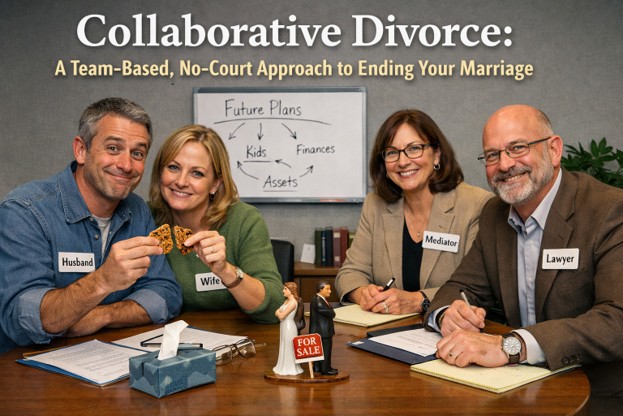
Collaborative Divorce: A Team‑Based, No‑Court Approach to Ending Your Marriage

Collaborative divorce is the “let’s not turn this into a courtroom drama” option.
It’s a structured, team‑based process where both spouses — and their attorneys — commit to resolving everything without going to court. No surprise hearings. No judge side‑eye. No dramatic “Your Honor!” moments.
More than 20 states have adopted versions of the Uniform Collaborative Law Act, and collaborative practice groups now exist nationwide. Translation: this isn’t fringe. It’s a real, respected alternative for couples who want privacy, control, and a less adversarial experience.
What Collaborative Divorce Actually Is
Collaborative divorce is a legal negotiation process built around transparency and teamwork. Here’s the gist:
- Each spouse hires a collaboratively trained attorney
- Everyone signs a participation agreement promising honesty and good‑faith negotiation
- Both attorneys must withdraw if either spouse chooses litigation
That last part is the defining feature.
It keeps everyone at the table because leaving the process means starting over — new attorneys, new fees, new everything. It’s the ultimate “let’s work this out like adults” incentive.
How Collaborative Divorce Works
1. Each Spouse Hires a Collaborative Attorney
These attorneys are trained specifically in collaborative law.
Their job is to problem‑solve, not posture. Think “strategic guide,” not “courtroom gladiator.”
2. Everyone Signs a Participation Agreement
This contract requires:
- Full financial transparency
- Respectful communication
- No court filings
- Withdrawal of both attorneys if the process collapses
This withdrawal clause is unique to collaborative divorce. Mediation doesn’t have it.
3. Joint Meetings Begin
Meetings include both spouses and both attorneys.
Depending on the case, the team may also include:
- A financial specialist
- A divorce coach or mental‑health professional
- A child specialist
These pros help keep negotiations efficient, child‑centered, and less “why are we arguing about this again?”
4. Information Is Shared Voluntarily
Unlike litigation — where discovery is compelled — collaborative divorce relies on open, voluntary disclosure.
No subpoenas. No depositions. No forensic accountant showing up like a plot twist.
5. Agreements Are Reached and Drafted
Once consensus is reached, attorneys draft the settlement for court approval.
No trial. No hearings. No adversarial motions.
Just signatures and a judge’s stamp.
Collaborative Divorce vs Mediation: How They Differ
People mix these up all the time, but they’re structurally different.
| Feature | Collaborative Divorce | Mediation |
| Professionals involved | Each spouse has their own attorney; optional specialists | One neutral mediator; attorneys optional |
| Decision‑maker | Spouses | Spouses |
| Legal advice during sessions | Yes — attorneys are present | No — mediator cannot give legal advice |
| Court involvement | None unless process fails | None unless mediation fails |
| Withdrawal requirement | Both attorneys must withdraw if litigation begins | No withdrawal requirement |
Collaborative divorce is more structured, more supported, and more attorney‑involved than mediation.
When Collaborative Divorce Makes Sense
It works best when:
- Both spouses want to avoid court
- Communication is possible (even if strained)
- Both are willing to disclose finances honestly
- There is no pattern of coercion, abuse, or intimidation
It is not recommended when there is domestic violence, severe financial dishonesty, or a major power imbalance.
(If one person controls everything, collaboration isn’t collaboration.)
Benefits of Collaborative Divorce
- Privacy — sessions are confidential, unlike public court hearings
- Control — spouses set the agenda and timeline
- Less adversarial — reduces emotional harm to families
- Team support — financial and child specialists can be included
- More personalized outcomes — agreements reflect your family’s needs, not a judge’s schedule
It’s basically the “custom build” version of divorce.
Risks and Trade‑Offs
- If the process fails, both attorneys must withdraw — meaning you start over
- It depends heavily on honesty and good faith
- Not suitable for high‑conflict or abusive dynamics
Collaborative divorce works beautifully when both people show up ready to work.
It falls apart when they don’t.
reStart Registry
If collaborative divorce helps you move forward, a Restart Registry helps you set up your next chapter with clarity — from home essentials to organization tools. No more guessing what you need or buying three can‑openers by accident.
Disclaimer
This article is for informational purposes only and is not legal advice. Divorce laws vary by state, and your situation may be different. Consider consulting a licensed attorney for guidance specific to your circumstances.